











In Stock
Reviews

In Stock
ReviewsWhy Decking Becomes Dangerous
New decking feels grippy. Within one or two UK winters, the situation changes dramatically. Algae, lichen, and green mould colonise the wood surface, creating an almost frictionless layer when wet. The Pendulum Test Value (PTV) of algae-covered wet decking regularly measures below 20 — in the "high slip risk" category according to the HSE. Anti-slip rubber changes this equation without requiring the cost of replacement boards.
Types of Non-Slip Rubber for Decking
Self-Adhesive Anti-Slip Rubber Strips
The fastest and most cost-effective solution. Peel-and-stick rubber strips are applied directly to deck boards, spanning the full board width. The raised rubber profile provides grip where feet land. Available in 25mm, 50mm, and 100mm widths. Apply every 3–4 boards for pedestrian use, every board for steep or high-risk areas. Suitable for wood, composite, and tiled decking surfaces.
Full-Coverage Rubber Decking Mats
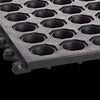
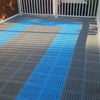
For maximum protection on entertaining areas, pool surrounds, and commercial hospitality decking, full-coverage rubber mats provide consistent grip across the whole surface. Available in interlocking tile formats (500×500mm) or roll-out mat format. Open-drain designs allow water to pass through the mat rather than pooling on top — preventing the mat surface itself becoming a water trap. UV-stable EPDM compound resists fading and surface cracking over years of outdoor exposure.
Rubber Stair Nosing Strips for Decking Steps
Decking steps are statistically the highest-risk point on any raised deck — the leading edge of each tread concentrates foot contact and receives maximum moisture. Rubber stair nosing strips with integrated anti-slip profile provide grip precisely at the most dangerous point. Available in self-adhesive and screw-fixed formats for permanent installation. UK Building Regulations Approved Document K requires adequate slip resistance on all external steps.
PTV Performance Data
| Surface Condition | Typical PTV | Risk Level (HSE) |
|---|---|---|
| New dry timber decking | 55–65 | Low |
| Wet treated timber decking | 30–40 | Medium |
| Algae-covered wet decking | <20 | High risk |
| Slip-Not rubber strips (wet) | 45+ | Low risk |
Installation — Anti-Slip Rubber Strips on Decking
- Clean first: Remove algae with a deck cleaner or dilute bleach solution. Rinse and allow to dry completely. Adhesive will not bond to wet, algae-covered, or dusty surfaces.
- Mark positions: Mark strip positions with chalk. Space anti-slip strips every 3–4 boards (150–200mm spacing) for standard pedestrian use.
- Peel and press: Peel backing paper and press firmly from one end, working out air bubbles. Use a roller to ensure full contact, paying attention to edges.
- Allow 24 hours cure time: Do not expose to rain or foot traffic for 24 hours after application. Most adhesive systems need 24h minimum for full bond.
- Inspect annually: Check edges for lifting each spring. Re-secure any lifting edges with weatherproof adhesive. Replace strips every 3–5 years or when the rubber surface profile is worn smooth.
Frequently Asked Questions — Non-Slip Rubber for Decking
Do anti-slip rubber strips damage wooden decking boards?
Self-adhesive strips do not damage decking boards. The adhesive is designed to bond to porous wood surfaces without penetrating the wood grain. When removed (typically after several years), the adhesive may leave minor residue that can be cleaned with a solvent cleaner. Screw-fixed rubber nosings leave small screw holes — fill with exterior wood filler if the nosing is later removed.
How long do anti-slip rubber strips last on decking?
Self-adhesive rubber anti-slip strips typically last 3–5 years on outdoor decking with normal UK weathering. UV exposure, frost, and repeated wetting/drying cycles gradually degrade the adhesive bond. Inspect annually in spring and re-secure any lifting edges. Full-coverage rubber mats with EPDM compound last 10–15 years. Replace strips when the raised surface profile is worn smooth — a flat rubber strip has lost most of its anti-slip function.
Can rubber anti-slip mats be used on composite decking?
Yes. Rubber anti-slip strips and mats work on composite decking (Trex, Millboard, etc.) as well as natural timber. For composite boards with a very smooth surface finish, choose a pressure-sensitive adhesive product rated for low-porosity surfaces, or use mechanical fixings. Open-drain rubber mat tiles are particularly suitable for composite decking as they prevent moisture trapping between the mat and the smooth board surface.
Is rubber anti-slip matting suitable for swimming pool decks?
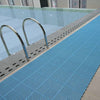
Yes — rubber anti-slip matting around pool surrounds is one of the most important safety interventions for both domestic and commercial pools. Specify open-cell or drainage-hole rubber mat tiles that allow pool water to drain freely rather than pool on the mat surface. EPDM compound provides long-term resistance to chlorine, UV, and wet conditions. Pool surround matting should achieve PTV 50+ when wet to provide adequate slip protection for barefoot users on wet surfaces.
Regulatory Compliance Reference — UK Rubber Flooring Standards
| Standard | Measures | Applies To |
|---|---|---|
| Workplace Regs 1992 Reg 12 | Floor suitability, maintenance, slip/trip prevention | All employers, all commercial floors |
| BS 7976-2 (PTV) | Pendulum Test Value — wet slip resistance | All pedestrian floor surfaces |
| DIN 51130 (R-rating) | Industrial ramp test — contamination-specific | Industrial, food, commercial kitchen |
| BS EN 1177:2018 | Playground impact attenuation by critical fall height | All playground safety surfacing |
| BS 8300 (Accessibility) | Inclusive building design — floor surface requirements | Public buildings, accessible routes |
| BS EN 61111 | Electrical insulating matting voltage class ratings | Switchrooms, substations, MCC panels |
| EC Regulation 852/2004 | Food hygiene — floor surfaces in food production | All food businesses, EHO inspection |
| HSE SAT (Slips Assessment Tool) | Comprehensive slip risk assessment framework | Employers assessing floor safety risks |
Rubber Matting vs Alternative Floor Solutions
| Property | Rubber | PVC Vinyl | Carpet | Epoxy Resin |
|---|---|---|---|---|
| Wet slip resistance | Excellent | Good | Poor | Good |
| Anti-fatigue benefit | Excellent | None | Moderate | None |
| Removable/reusable | Yes | No (bonded) | Some | No |
| Oil resistance (NBR) | Excellent | Good | Poor | Excellent |
| Temperature range | -40°C to 130°C | 0-60°C | 5-40°C | -20-80°C |
| Service life (commercial) | 10-15 years | 7-12 years | 3-8 years | 8-15 years |
Ordering from Slip-Not
All products cut to your exact dimensions. No minimum order. Same or next working day dispatch on stock items. Free UK mainland delivery. Technical specification advice from our team — no obligation. Independent test certificates and compound data sheets available on request. If our product isn't the right specification for your application, we'll tell you.
Non-Slip Rubber for Decking — Complete Guide
Why UK Decking Becomes Dangerous
The UK climate creates uniquely hazardous conditions for outdoor decking. Mild, damp winters allow algae and lichen to colonise wood surfaces year-round. The result: decking that achieves PTV 55-65 when new and clean achieves below PTV 20 when algae-covered and wet — the HSE's "high slip risk" threshold. The transformation from safe to dangerous typically occurs within 2 UK winters. Anti-slip rubber converts the hazard into a compliant surface without the cost of decking replacement.
Commercial Liability
For commercial premises with outdoor areas (pub beer gardens, restaurant terraces, hotel grounds), the Occupiers' Liability Acts 1957 and 1984 create ongoing legal duty. A slip on algae-covered wet decking is a foreseeable and preventable hazard — operators who fail to address it face significantly weakened liability defences. Anti-slip rubber treatment with documented PTV certification is the standard defensible control measure. Maintain records of: installation date, product PTV rating, and annual inspection.
Domestic Liability
For domestic gardens, the combination of children, elderly visitors, and social gatherings on decking creates genuine risk. Domestic insurance claims from decking slips are common and costly. Anti-slip strips at £25-50 total for a standard garden deck represent exceptional value against even one minor injury claim.
Product Selection Guide
Self-adhesive rubber strips (50-100mm wide): Quickest and most cost-effective. Apply every 3-4 boards for standard pedestrian use; every 2 boards for higher-risk areas (elderly users, children, steep sections). Last 3-5 years in normal UK conditions. PTV 45+ when wet.
Full-coverage rubber tiles (interlocking 500x500mm): Maximum protection for entertaining areas, commercial hospitality decks, pool surrounds. Open-drain format prevents water pooling. PTV 50+ when wet. EPDM compound for UV stability (SBR degrades in outdoor UV within 2-3 years). Lasts 10-15 years.
Rubber stair nosing strips: For all deck steps — the statistically highest-risk point on any raised deck. The leading edge of each step concentrates foot contact and moisture. Purpose-designed rubber nosing with bevelled front edge. Colour contrast options for visibility under BS 8300 accessible design requirements.
Slip-Not — UK Rubber Matting Specialists
Slip-Not is a UK rubber matting specialist — providing SBR, EPDM, nitrile, neoprene, and specialist rubber flooring to industry, commerce, equestrian, and domestic customers. We supply independent test certificates, compound data sheets, and compliance documentation with every commercial order.
Why Specification Matters
The wrong rubber compound in a slip-critical environment doesn't just fail early — it creates a false sense of security that could leave an employer with inadequate protection against a Regulation 12 claim. At Slip-Not, our approach to specification is straightforward: we match the product to the application requirements, provide the compliance documentation to support your health and safety management, and will tell you if a competitor's product is more appropriate for your specific requirement.
Key Compound Selection Rules
- Petroleum oil contact: Nitrile (NBR) only — SBR fails within months
- Permanent outdoor UV: EPDM only — SBR cracks in 12-18 months outdoors
- Food production contact: Food-grade EPDM or nitrile with EC 1935/2004 documentation
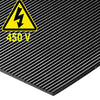
- Electrical switchrooms: BS EN 61111 classified insulating matting only — standard rubber contains conductive carbon black
- General indoor commercial: SBR is appropriate and most economical
Ordering from Slip-Not
All products cut to your exact dimensions. Standard widths 1m, 1.22m, 1.4m, 2m in all profiles. No minimum order. Same or next working day dispatch. Free UK mainland delivery. Call our technical team for specification advice — we provide genuine guidance, not just sales.
Anti-Slip Rubber Decking — FAQ
Do anti-slip rubber strips affect the appearance of decking?
Black rubber strips on timber decking are visible but unobtrusive — many homeowners find the regular grid of strips provides a professional, purposeful appearance similar to marine decking. For minimal visual impact, use 25mm wide strips in a colour-matched profile. For composite decking in lighter colours, consider translucent rubber strips that allow the decking colour to show through while providing grip.
Can anti-slip rubber be installed on wet decking?
No — adhesive-backed strips require dry, clean surfaces. Wait for dry weather and full surface drying (minimum 24 hours after rain). Clean thoroughly to remove algae. Wipe with isopropyl alcohol immediately before applying strips. In UK conditions, early May to mid-September typically provides the best installation window for consistent dry weather.
How much does anti-slip decking rubber cost for a typical garden deck?
For a standard 3m x 4m garden deck using self-adhesive strips every 3 boards (standard spacing), cost is approximately £25-60 total for materials. Full-coverage rubber tile installation on the same deck costs £200-450 depending on tile specification. Compared to professional deck cleaning and anti-slip paint (£150-400 plus regular maintenance), rubber strips provide a more cost-effective and longer-lasting solution.
What width anti-slip rubber strip is recommended for decking?
50mm width is the most popular for standard timber decking — wide enough to capture the forefoot on each tread while remaining unobtrusive. For composite decking with very smooth surfaces, 75mm provides more grip area. For ramps and slopes, 100mm provides additional grip contact on the most safety-critical surfaces. All widths are available in self-adhesive format from Slip-Not.
Anti-Slip Decking Rubber — Materials Reference
Self-adhesive strips (50mm, 75mm, 100mm width): Most popular for domestic and light commercial use. Apply every 3-4 boards. 3-5 year service life in UK outdoor conditions. PTV 45+ wet. EPDM compound — UV stable, frost resistant.
Interlocking rubber tiles (500x500mm): Full-coverage solution for commercial hospitality decking, hotel terraces, restaurant outdoor areas. Open-drain design prevents water pooling. PTV 50+ wet. EPDM compound. 10-15 year service life. No adhesive — remove and replace individual tiles as needed.
Rubber stair nosing strips: For all deck steps. The leading edge of each step is the statistically highest-risk point on any raised deck. Purpose-designed rubber nosing with bevelled front profile and contrasting insert for visibility. Available in self-adhesive and screw-fixed formats. BS 8300 compliant colour-contrast options for accessible building requirements.
All products UV-stabilised EPDM compound for permanent outdoor UK installation. PVC-free. Same or next working day dispatch. Free UK mainland delivery. Call for specification advice on any decking anti-slip requirement.
Anti-Slip Decking — Professional Installation Guide
Step-by-Step for Self-Adhesive Strips
- Surface preparation (Day 1): Apply deck cleaner or 5% bleach solution. Scrub with stiff brush. Rinse thoroughly. Essential: all algae and contamination removed at this stage — adhesive will not bond to contaminated surfaces.
- Drying (Day 2): Allow minimum 24 hours of dry weather. In UK conditions, 48 hours is safer if any rain is forecast. Do not proceed with damp decking.
- Surface activation: Wipe application positions with isopropyl alcohol (IPA) wipe immediately before applying strips. This removes any remaining wax, silicone treatment, or surface residue that would prevent adhesion.
- Marking positions: Mark strip positions with chalk line — every 3-4 boards for standard use; every 2 boards for higher-risk areas; every board for steep sections (>5% fall) and areas used by elderly or mobility-impaired users.
- Application: Peel 100mm of backing paper from one end. Position the strip end accurately. Lower the strip onto the surface without stretching — stretching causes the strip to curl back after application. Press from one end progressively, peeling backing as you go.
- Consolidation: Use a rubber roller or the heel of your hand pressed firmly along the full length, especially at strip edges. Edges are the point of maximum adhesive stress — ensure full contact.
- Cure: Protect from rain, dew, and foot traffic for minimum 24 hours. At temperatures below 10°C, extend to 48 hours.
Maintenance Schedule
Spring (annual): Full inspection — check for any lifting edges. Press down any lifting sections with rubber roller and additional adhesive. Clean decking and strips with deck cleaner to remove winter algae growth.
Autumn: Leaf clearance — wet leaves on rubber strips significantly reduce their grip effectiveness. Weekly clearing during heavy leaf fall periods.
Every 3-5 years: Replace self-adhesive strips — adhesive bond degrades with freeze-thaw cycling. Replace when surface profile is worn flat. EPDM compound mats last 10-15 years; only strips may need replacement.
All anti-slip decking rubber products UV-stabilised EPDM compound. Free UK mainland delivery, same or next working day dispatch. Call for specification advice on any decking anti-slip requirement.
All Slip-Not anti-slip decking products dispatch same or next working day from our UK warehouse. EPDM compound throughout for long-term outdoor UV stability. Independent PTV wet test certificates available on request — essential documentation for commercial premises liability management. Free UK mainland delivery. Call our outdoor rubber team for specification advice on any decking or outdoor anti-slip application.
Quick Specification Summary
Self-adhesive strips: Best for domestic gardens and light commercial decking. 50-100mm wide. Apply every 3-4 boards. 3-5 year service life. EPDM compound. PTV 45+ wet. From £1.50/m.
Interlocking rubber tiles: Full-coverage solution for commercial hospitality, hotels, restaurants. Open-drain format. PTV 50+ wet. EPDM compound. 10-15 year service life. No adhesive needed. From £15/m².
Stair nosing strips: Mandatory for all deck steps. Bevelled front edge. Contrasting colour insert. Screw-fix format recommended for commercial installations. All products UV-stabilised, frost-resistant.
Anti-slip rubber strips 50mm, 75mm, 100mm wide. Interlocking EPDM tile 500x500mm. Stair nosing strips standard and contrast-insert formats. All UV-stabilised EPDM compound for permanent outdoor UK installation. Free UK mainland delivery.
All products available same or next working day dispatch. Free UK mainland delivery. EPDM compound throughout — UV-stable, frost-resistant, 10-15 year outdoor service life. PTV test certificates on request. Call our outdoor rubber team for any specification or installation query.
Slip-Not anti-slip decking rubber is manufactured to UV-stable EPDM specification — the only correct compound for permanent outdoor UK installation. Independent PTV 45+ wet slip resistance test certificates available for all products. Full-coverage EPDM tiles achieve PTV 50+ wet for barefoot and high-risk applications. Free UK mainland delivery, same or next working day dispatch, no minimum order.
All products dispatched from UK stock. Anti-slip rubber strips cut to any length. EPDM compound throughout. UV-stable, frost-resistant. Free mainland UK delivery.
All Slip-Not anti-slip decking products use UV-stabilised EPDM compound for long-term outdoor performance. Free UK mainland delivery. Same or next working day dispatch.
Specification: EPDM compound. PTV 45-50+ wet. Frost-resistant.
What Our Customers Say
Verified reviews from UK buyers — Free UK delivery
Frequently Asked Questions
Do you offer free UK delivery?
Yes, we offer free UK mainland delivery on most orders. Delivery to Scottish Highlands, Northern Ireland, and offshore islands may incur a surcharge. Orders are typically dispatched within 24-48 hours.
Can I order samples before purchasing?
Yes, we offer free samples of most products. This allows you to check colour, texture, and quality before committing to a larger order. Contact us to request samples.
Do you cut rubber matting to size?
Yes, we offer a cutting service for rubber rolls and sheets. Provide your measurements and we'll supply pre-cut pieces ready for installation. Custom cutting may extend delivery times.
What payment methods do you accept?
We accept all major credit and debit cards, PayPal, and bank transfer. Business customers can apply for credit accounts with 30-day payment terms. All transactions are securely processed.
What is your returns policy?
We offer a 30-day returns policy on unused products in original packaging. Custom-cut items cannot be returned unless faulty. Please contact us before returning any items.
